Global equity is not a zero-sum equation
Average people residing in rich western countries are being dealt an increasingly terrible financial hand and lived experience. This fact can and should be used to mobilize them to the cause of international solidarity.

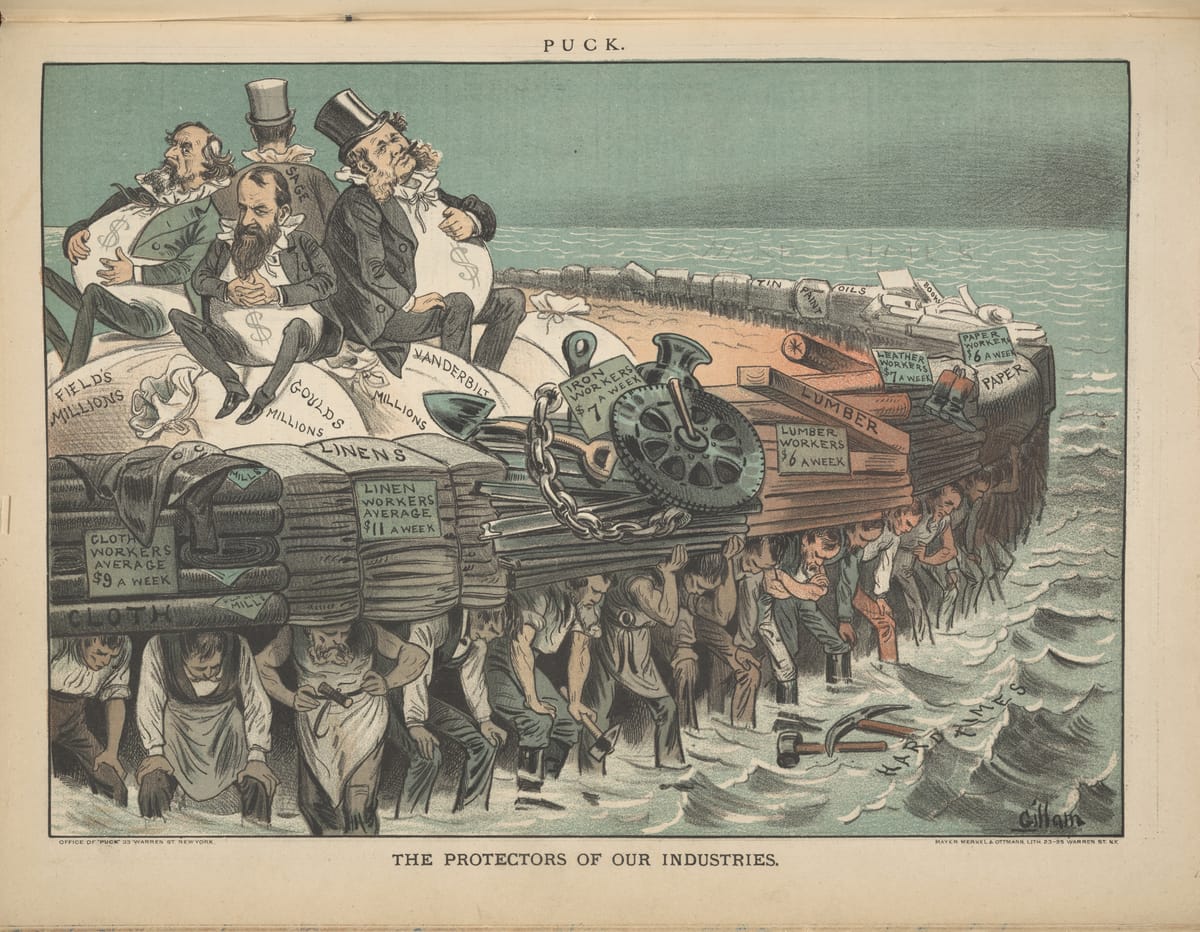
In the final analysis, the economic development of the United States and the need of its workers to maintain their standard of living means that our struggle for national liberation is not waged against a given social regime, but rather against the whole nation, bound as a bloc by the iron-clad supreme law of common interest, over their domination of the economic life of Latin America.
Che Guevara, the now-famed Argentine Marxist revolutionary who would eventually aid in liberating Cuba from its American puppet dictatorship under Fulgencio Batista, penned these words in a screed from 1954 titled, La clase obrera de los Estados Unidos… ¿amiga o enemiga? (The United States Working Class… Friend or Foe?). As spoiled in the excerpt above, by the end of the piece, Che definitively responds to the question posed in the title: workers in the American core are not to be seen as allies to their working class counterparts the world over, he believed. The reason that the tensions wrought by proletarianization[1] and the inequality necessarily wrought by profit seeking had not manifested in American society was expressly because of its position as a global labor aristocracy, Che argued. In essence, Americans stood to lose more from the dissolution of global capitalism[2] than any other working population.
Che seemingly did not imagine that the expansion of neoliberal global capitalism would also expand the gap between productivity and wages. In the nascent days of the new global order dominated by American capitalism in the aftermath of World War II, American workers did enjoy real and meaningful benefits over their class-counterparts elsewhere in the world, but novel technologies like the Internet, cargo container ships, and developments in manufacturing would enable rearchitecting global value chains and the offshoring labor. What has come to be colloquially known as globalism would take root in tandem with the rise of shareholder primacy, the deliberate erosion of labor bargaining power, and an increasing allocation of state budget toward a ravenous war machine, all of which would disrupt that comfortable complacency that Americans were bribed into accepting through, as Che put it, relatively "enormous wages". American workers have increasingly been cut out of this already rotten and lopsided deal.
Don't confuse my argument: in many respects, conditions in much of the Global South have continued deteriorating in ways that markedly contrast its residents' average living conditions with their class-counterparts in the United States and the West writ large. Look no further than the ever-escalating mass atrocities executed in the Middle East and Asia, from Iraq to Afghanistan to Palestine. Or consider the labor practices in places like the Democratic Republic of the Congo, where children scrape minerals from caverns by hand to supply rare earths used in the production of consumer electronics. In other respects, living conditions in regions like China and Latin America have ticked up by many measures, not always linearly, but often tremendously. Over the same period of time where American productivity drifted further and further apart from real wages, China has eradicated extreme poverty, bringing the figure from around 80% of their population to practically zero, over the same period of time. Even still, as global supply chains have spindled their web around the world these past seventy-odd years, the surplus benefit of global expropriation has been captured by a staggeringly and increasingly tiny cohort of elites, while the average Westerner experiences stagnation or degradation: increased rates of homelessness, longer working hours, lower relative wages, and the privatization of essential services. There are impoverished communities in the American South, Appalachia, and of Indigenous and Black people which experience levels of life expectancy, environmental poisoning, an educational gap, and infrastructural mismanagement comparable to many poorer developing nations. Many in radical circles are quick to apply Che's argument anachronistically to our current moment, so as to write off any effort to mobilize Americans towards an equitable, multi-polar global order, let alone overtly anti-imperialist or anti-capitalist aims, as an ill-conceived waste of time. But as the data demonstrates, Western quality-of-life is not an indivisible function of Southern exploitation; rather, a transition away from corporate globalism towards a movement of internationalism which places the needs and interests of working populations tantamount to all else would entail a rising tide to lift all ships.
The Immense Magnitude of Global Value Appropriation
Though countries in the periphery of empire have long been subject to exploitation since the peak of old-school settler colonialism, the dissolution of those classic forms of colonialism into financial neocolonial models of subjugation have actually intensified, rather than abated, the uneven transfer of value. With the proliferation of the US dollar as the world reserve currency, debt-trap diplomacy, and the systematic undervaluation of labor and resources from developing nations, increasingly staggering quantities of said labor and resources are being siphoned from the Global South across all skill levels.
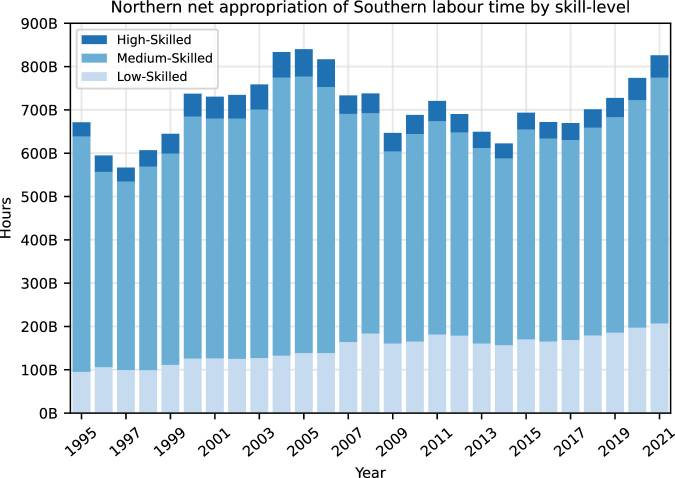
An article published by Jason Hickel et al. attempts to put a figure to this uneven exchange. The researchers found that, in 2021 alone, Western capitalist hegemons net-appropriated 826 billion hours worth of labor from the Global South, a figure which roughly translates to €16.9 trillion. For context, the scale of this labor dwarfs the total labor rendered annually by the United States and the European Union combined. Southern workers contribute 90% of the labor powering the global economy while receiving only 21% of the global income. Many of these nations are pressured into accepting predatory loans from institutions like the International Monetary Fund, or Western nations' foreign policy coerces states to or supports dictatorships which protect the rights of Western corporations to pilfer these subjects. Complex supply chains can obstruct the manners in which slavery, child labor, and unpaid overtime factors into the production of commodities like consumer electronics and food. Children in the Democratic Republic of the Congo work overtime by western standards, scraping walls by hand to mine ores used in the production of consumer electronics, while companies like Apple report gross margins exceeding 40%, margins surely underpinned by the repatriation of surplus value from exploited countries in their complex supply chain like in the DRC. However, that surplus doesn't bolster the wages of service or retail employees to a degree that reflects the firm's profitability; instead, that wealth gets directed towards shareholders, predominantly composed of already tremendously wealthy figures, through buy-backs and executive bonuses.
The Internet's facilitation of a global information economy has accelerated this divide even further. Even skilled laborers in the realms of engineering or scientific research generally go significantly underpaid in these regions, often less than their low-skilled counterparts in the Global North. Rather than devote their wits and energy to the development of their own nations, talented information employees are being enticed for what amounts to pennies on the dollar to work for American firms as contractors with fewer rights and benefits, and less compensation than their full-time counterparts.
Imperial rent is not merely a byproduct of industrial compositions, but a deliberate consequence of the geopolitical suppression of wages and prices in the global economic periphery.
The Fractured National Bloc - Why the Imperial Bribe is Ending
In the aftermath of World War II, the United States had found itself well positioned to become the arbiter of international economic trade, having suffered relatively low casualties and costs compared to the other Great Powers. Thanks to the newly robust social safety net and a policy regime that bolstered union participation and labor rights, agitated for by progressives and radicals and instantiated under Franklin Delano Roosevelt's administration, the general public briefly enjoyed common interest with capital on the global stage. But the corporate class felt encumbered by this dependency and almost immediately got to work unraveling this dynamic. In 1947, Congress passed the Taft-Hartley act to massively restrict the powers of labor unions, prohibiting wildcat strikes, solidarity strikes, certain forms of boycott, and the establishment of shops that required union membership. This crackdown, which remains ongoing to this day, in parallel with opportunistic business-unionist leadership, has sent union density backsliding from its peak of around 1/3 of the workforce in the 1940s to just around 10% today, even despite the recent uptick in union optimism and popularity.
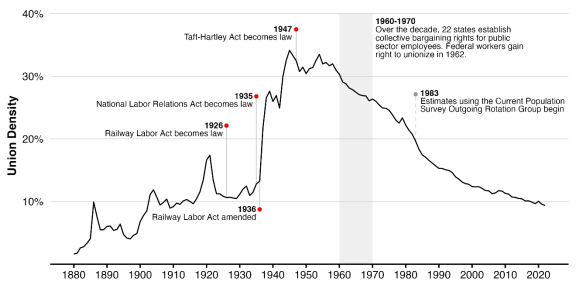
With collective bargaining power being actively dismantled, an atomized workforce would prove feeble to act as the United States would transition toward a neoliberal, globalized economic model. It's a story most have become intimate with by now: factories and steel plants wound down across the Rust Belt as work was outsourced to cheaper, more easily exploitable developing nations. As articulated above, these were often vassal states who, through various means, were subject to the installation or persistence of autocratic regimes who would not extend the sorts of basic labor protections many had come to enjoy in the West through agitation. This same dynamic is beginning to manifest in European nations that have historically resembled social democracies, characterized by robust welfare states and Keynesian economics. Often highlighted by American left-electeds as a potential model for equalizing the American economy, center-left politics in these Nordic countries have seen a marked decline in popularity from their 20th-century highs in the face of globalization, deregulation, and reactionary far-right parties scapegoating immigrants (sound familiar?).
As a result of this dynamic, there are entire communities in the United States which are experiencing conditions akin to low-income nations in the global periphery. Some counties on the Mississippi Delta experience life expectancy as low as 68 years. Paved roads, Internet service, and sometimes even plumbing can be hard to come by in Appalachia and The Colonias. Native reservations in the Great Plains sometimes record unemployment rates above 80% and also often lack access to basic public infrastructure. And then, in virtually every urban center in the country, you will find pockets predominantly composed of minority groups concentrated into what are effectively slums with dilapidated infrastructure and a dearth of services like grocery stores, transit centers, and high-quality schools (oftentimes a direct consequence of historical policies deliberately engineered to target Black people in the wake of emancipation and the Civil Rights movement).
Decoupling HDI, GNI, and Actual Well-Being
Despite the fact that pockets of the United States are host to abhorrently neglected communities, the majority of Americans still enjoy a decent quality of life. The sustenance of the American middle class has long been a political bulwark against real political action opposing corporate overreach. That middle class, anxious and self-aware, is standing on an increasingly precarious, shrinking base of existence, but still forms a solid majority, and in many respects, enjoys a quality of life vastly superior to the global majority.
What I wish to refute is not only this notion that Americans can't be compelled to ally themselves to the cause of international economic equitablity, but also this assumption that high levels of human development and a rich quality of life necessarily requires extreme resource consumption. In fact, I would suggest that this very same expropriation wielded against the periphery is motivated by the exact same insatiable corporate hunger which is increasingly turning inwards on the American populace. The systemic enemy of all working peoples is one and the same. Most importantly, Americans would not need to sacrifice anything but perhaps the worst and most frivolous excesses of their lifestyles in order to produce a globally universal decent standard of living.
In conversations of this sort, rankings of countries by Human Development Index (HDI), an index first produced in 1990 as a means of ranking human prosperity beyond typical economic indicators, are often bandied to demonstrate that high-income, imperial core nations tend to rank favorably, implicitly largely as a consequence of their raw material and wealth drain on the periphery. The United States ranks around 17th, which of course is relatively high when considered against every other nation in the running. However, considering that the United States is possibly the richest nation in history, it dwarfs its statistical HDI neighbors many fold in factors like gross domestic product and gross national income (including per-capita). Obviously, this would suggest that income is not directly proportionate to human development and prosperity. Even then, HDI itself incorporates GNI as a substantial consideration, implicitly favoring high-consumption models of economic activity. The linked article (also by Jason Hickel) illustrates this point through Costa Rica, a nation with higher life expectancy and measures of happiness comparable to Scandinavian social democracies, despite only scoring around 0.81 HDI. Jason argues that this comparatively lower score is in large part a function of the nation's modest average income of around $11,000. When diminishing the weight of GNI in the calculation, Costa Rica's ranking becomes much closer to the United States, despite a material footprint less than half the amount per capita. Costa Rica achieved this by abolishing its military and redirecting those funds towards socialized services to address basic human needs.
This material footprint discrepancy can be staggering, often 20 times larger than nations with comparable levels of happiness. In other words, this suggests the existence of a redundancy: that significant portions of Northern consumption are not directed toward meeting human need, but are instead focused on growing revenue, sating the insatiable profit motive central to our economic system. So much of the imperial rent siphoned from the South is used to produce low quality fast fashion, tech gadgets with short obsolescence timelines and poor repairability, mass-produced hyper-palatable food stuffs contributing to the obesity crisis... phenomena increasing shares of people understand implicitly to be decreasing our quality of life. Places like Costa Rica and Sri Lanka, by contrast, haven't uncovered some novel secret; rather, they have simply invested heavily into public, social infrastructure capable of accommodating a greater number of people with a smaller material footprint.
America's obsession with cars is a crystalline microcosm of this phenomenon. Private vehicles are inherently inefficient, carrying one or two passengers while necessitating a comparatively superfluous use of land and fuel. A German study found the lifetime social cost of car ownership to be in the hundreds of thousands of dollars (far beyond what is recouped through registration fees and taxes). Regardless, the financial burden of car ownership for the median worker is also increasingly staggering and disproportionate; in some states, people spend nearly a fourth of their disposable income on average on vehicle ownership. The car itself represents a sort of roving metal prison. Its requirements promote the development of endless sprawl, exacerbating an increasingly isolating existence for the average worker, who lacks direct access to third places in their neighborhood and has a weak connection with people and their direct environment as a result of the proliferation of this hyper-individualized mode of transit hostile to all other forms of movement. Investment in robust, safe public infrastructure to facilitate biking, buses, trains, and urban rail would address the relatively massive per-capita resource expenditure that is a function of individual vehicle ownership while liberating people from the stresses, burdens, and second order impacts of automotive dominance. People would be given greater opportunity to move, exercise, interact with others and their environment. These alternative modes of commuting have demonstrably been linked to higher levels of happiness. And a pattern begins to emerge when you make similar analyses in the domains of healthcare, food production, consumer electronics, and many other domains in which the West is particularly resource hungry: luxurious and publicly socialized alternatives can lower our material footprint whilst improving our average quality of life.
In severing the siphons pumping wealth from the world's most under-served peoples into the hands of a vanishingly small elite presiding in wealthier nations, our first and primary objective should be improving conditions for those very populations suffering under conditions of abject dejection and subjugation. Doing so may constitute a change in the allocation of wealth and resources for the labor aristocracy in the "developed" world, but those changes can and should represent a positive development for all involved. By shifting our focus to building out sustainable, socialized public luxuries at scale, we can transition away from the vacuous patterns of relatively immense consumption that leave most Americans feeling empty, alienated, isolated, and unhealthy. Even besides that, a huge share of the wealth being expropriated isn't even directly benefiting the average Westerner. Americans can and should be made to be allied to the cause of internationalism and global equity, because unless we birth a miracle capable of sustaining our current resource footprints for the entire world, the alternatives are the irrevocable acceleration of the climate catastrophe or, as is already occurring, the degradation of Western living standards as corporations continue setting their sights on domestic targets to squeeze. It should be an easy sell; we just have to actually try and make the appeal.
[1] Proletarianization in this instance meaning the consolidation of working populations away from self-sustaining modes of employment like agriculture and small business into urban centers to do commodity production and service labor for employers.
[2] By "global capitalism", both Che and I mean the massively uneven expropriation of the surpluses of global labor by a vanishingly small elite class through the threats of force, militarism, and debt-trap diplomacy.